The short version. At about 19:26 on 21 October 2024, a westbound Transport for Wales train on the Cambrian line failed to stop in the passing loop at Talerddig, Powys, ran 1,080 metres past its stopping point, and hit an eastbound train head-on on the single track beyond. One passenger died and four people were seriously injured. The Rail Accident Investigation Branch (RAIB) found that the rails were slippery, though not unusually so for that place in October; that the train’s automatic sander probably did not work because of electrical faults that its routine test could not detect; that the driver did not use the separate emergency sander; and that the train approached the loop too fast for the grip available. Beneath that, it identified a possible deeper cause: the signalling scheme’s assumptions had come to depend on the trains’ sanders working, and RAIB found no evidence that anyone involved had recognised it. The report makes nine recommendations. As of 18 October 2026 I could find no published response to any of them.
Report card
- Investigator: Rail Accident Investigation Branch (RAIB), UK
- Report: 08/2026, Collision between two passenger trains near Talerddig, Powys, 21 October 2024
- Published: 18 June 2026, 139 pages
- Recommendations: 9, plus 1 learning point
- Recommendation status last checked: 18 October 2026
- Read it: RAIB report 08/2026 on GOV.UK
References in brackets, like (para 52), are to the numbered paragraphs of the RAIB report.
The Cambrian line, ERTMS and the class 158 trains
The Cambrian lines (often called the Cambrian line) run from Shrewsbury across mid-Wales to Aberystwyth and Pwllheli. Most of the route is a single track, with passing loops where trains going in opposite directions can get past each other (para 13). Talerddig loop sits on a summit. Westbound trains climb to it; beyond its western end, the line drops away at about 1 in 56 (paras 18, 244).
Since 2011 the Cambrian lines have been signalled with ERTMS, the European Rail Traffic Management System, at level 2. There are no lineside signals. Instead, each train receives a “movement authority” by radio, which tells it how far it may go, and a screen in the cab shows the driver the speed allowed now and coming up. Equipment on the train watches its speed and position continuously and applies the brakes if it is going too fast or is likely to pass the end of its authority (para 31). The Cambrian installation was a pilot, meant to teach Network Rail how to roll ERTMS out elsewhere (para 31).
Both trains were two-car class 158 diesel units, built between 1989 and 1992, leased from Angel Trains and maintained by Transport for Wales Rail Limited (TfWRL) (paras 22, 25-30). Class 158s were built without sanders. Sanders were added after the trains proved prone to sliding in low adhesion: first a one-shot emergency sander in the late 1990s, then an automatic sander around 2001. TfWRL kept both (paras 79-80).
What happened
The plan. Train 1J25, the 18:31 from Shrewsbury to Aberystwyth, was to arrive first, take the Up Loop (one of the two tracks through the passing place) and stop at block marker MH1078, a lineside board marking the end of its movement authority. Train 1S71, the 19:09 from Machynlleth, would then run through on the other track, the Down Loop, without stopping. The signaller chose this order so that the eastbound train, climbing the steeper bank, could use the Down Loop’s higher speed limit (paras 49-51). Both drivers expected to pass each other there (para 49).
The approach. At about 19:22, 1J25 shut off power at 125 km/h, with about 1,900 metres to its stopping point. Over the next 39 seconds the driver made two light brake applications, releasing the brakes after each, and then let the train coast for about 5.5 seconds (paras 52, 231, 234). At about 730 metres from the stopping point the driver selected brake step 2. Three or four seconds later the signalling system applied full service braking by itself, because the train was too fast to meet the 50 km/h limit through the loop entrance; the driver says they applied it at about the same moment (paras 53, 234). About a second after that, the wheel slide protection system began working, which means the wheels were sliding (para 53).
Six seconds later, at about 80 km/h, the signalling system demanded an emergency brake application. On a class 158 that gives no more braking than full service; it simply cannot be released (paras 54, 86, 221). The train entered the loop at about 70 km/h (para 210).
Known at the time. It was dark. A light shower had crossed the site around 19:05-19:10 and cleared before 1J25 started braking; the driver did not see rain and was probably unaware the rails were damp (paras 117-120). No driver had reported unusually low adhesion near Talerddig that day (para 142). The cab gives no indication of whether the automatic sander is actually delivering sand (para 83).
The overrun. The driver called the signaller on the train radio to say the train was “sliding through Talerddig and going to pass the block marker, I think” (para 282). It was an ordinary call, not a railway emergency call. The train passed MH1078 at about 54 km/h, ran through the points at the end of the loop at about 33 km/h, and entered the single line on the downhill gradient (paras 55-56). From there, with the brakes still fully applied, it did not slow down at all: the braking it could get on the contaminated rail was cancelled out by gravity (para 245).
The signaller then called the driver of 1S71, telling them that 1J25 “has just slid past the block marker in the loop and is occupying the points”, and instructed them to continue and stop at the end of their own authority, block marker MH1081 (paras 58, 283). Nothing in that message suggested 1J25 was still moving. 1S71’s driver mentioned they were themselves struggling for grip on the climb (para 58).
The collision. The driver of 1J25 phoned the guard, then left the cab about 10 seconds before the collision and warned passengers in the front coach (para 59). 1J25’s headlights came into view of 1S71 about 13 seconds before impact. Its driver applied the emergency brake and was trying to leave the cab 3.7 seconds before the trains met, almost certainly in response to seeing them (paras 60, 279). 1J25 was doing about 39 km/h, 1S71 about 11 km/h. 1J25 was 1,080 metres past its stopping point and 360 metres past the place 1S71 had been told to stop (para 61). The trains struck a second, lighter blow about five seconds later and came to rest together (para 62).
Afterwards. The first 999 call, from 1S71’s guard, was at 19:28. The driver of 1J25 made a railway emergency call from the rear cab just over two minutes after the collision. The first fire engine arrived at 19:57; coastguard and air ambulance helicopters were also sent (paras 63-65). A passenger on 1J25 died. Three people on 1J25, including its guard, and the driver of 1S71 were seriously injured; 23 others reported minor injuries (paras 9-10). Neither train derailed. The line reopened on 28 October (para 12).
Why it happened
RAIB keeps its findings in a fixed structure: an immediate cause, causal factors, factors that made the consequences worse, and underlying factors (the organisational conditions behind the rest). I have kept that structure so you can see their reasoning. Where RAIB says “probable” it means highly likely; “possible” means there is real uncertainty (report preface).
The immediate cause is plain: 1J25 passed its stopping point and entered a single line occupied by 1S71 (para 417).
1. Why 1J25 could not stop in the loop
Three things combined (para 418a).
The rails were slippery, but not extraordinarily so. RAIB rebuilt the stop on a hardware-in-the-loop rig that uses the train’s own recovered wheel slide equipment. The best match to the recorded speeds was a peak friction coefficient of about 0.06 on the approach, which the industry’s own manual classes as “low” and describes as typical of an autumn morning. RAIB says this was “not exceptional” for Talerddig in October (paras 74, 128-133). Storm Ashley had stripped a lot of leaves from trees the day before; the railhead treatment train (a train that cleans leaf film off the rails) had water-jetted the line the night before, as planned, without applying any adhesion-improving gel, which was the route’s policy. Its jets were switched off over points and while it stood in the loop, so about 211 metres (46%) of the path 1J25 later took through the loop was not jetted; RAIB found no evidence that those gaps affected the accident (paras 44, 115, 139-140). In the loop, the train slowed at 3-4% of g (the acceleration due to gravity) under full braking when it should have managed about 9% (para 106). RAIB checked the brakes thoroughly and found nothing wrong with them (para 107). Had adhesion been medium or high, the train would have stopped where it should, sand or no sand (para 146).
Neither sander delivered sand.
The automatic sander is triggered by the wheel slide protection system when the train slides under braking. After the accident, both of its delivery hoses on the leading vehicle were found plugged with leaf material, with no sand behind the plugs (paras 154-157). RAIB’s tests, which it notes had limitations, indicated that a working sander would probably blow such plugs out, so the plugs were probably a sign the sander had not been firing rather than the reason it failed (paras 172-180). Testing then found two electrical faults in the sander’s control circuit: a cab isolation switch whose contacts had gone high-resistance, and a low-speed relay (LSR4) with an intermittent break in its coil circuit that opened under slight pressure on its case (paras 162-171). Either fault, if present at the time, would have stopped the sander working. RAIB judged the relay the more likely culprit, partly because the switch fault had probably developed after the accident, while the train sat awaiting tests (paras 185, 192).
The sander was tested, and passed, at a depot examination on the night of 19 to 20 October and again when the train was prepared on the morning of 20 October, the day before the crash (paras 41-42). But the test was done by pressing a button on the underframe that energises the sand valve through a separate circuit, bypassing both the isolation switch and the LSR4 relay (paras 161, 360). The test proved that sand would come out of the hoses; it could not prove that the control circuit would open the sand valve when the wheels slid. A fault in that circuit could sit undetected until the next depot examination, up to a fortnight away, while the frequent passing tests gave “a false impression that the automatic sanding system was fully operational” (para 361). The last test that exercised the real circuit was a depot examination nine days earlier; because the relay fault was intermittent, it may already have been there (paras 185-186, 359).
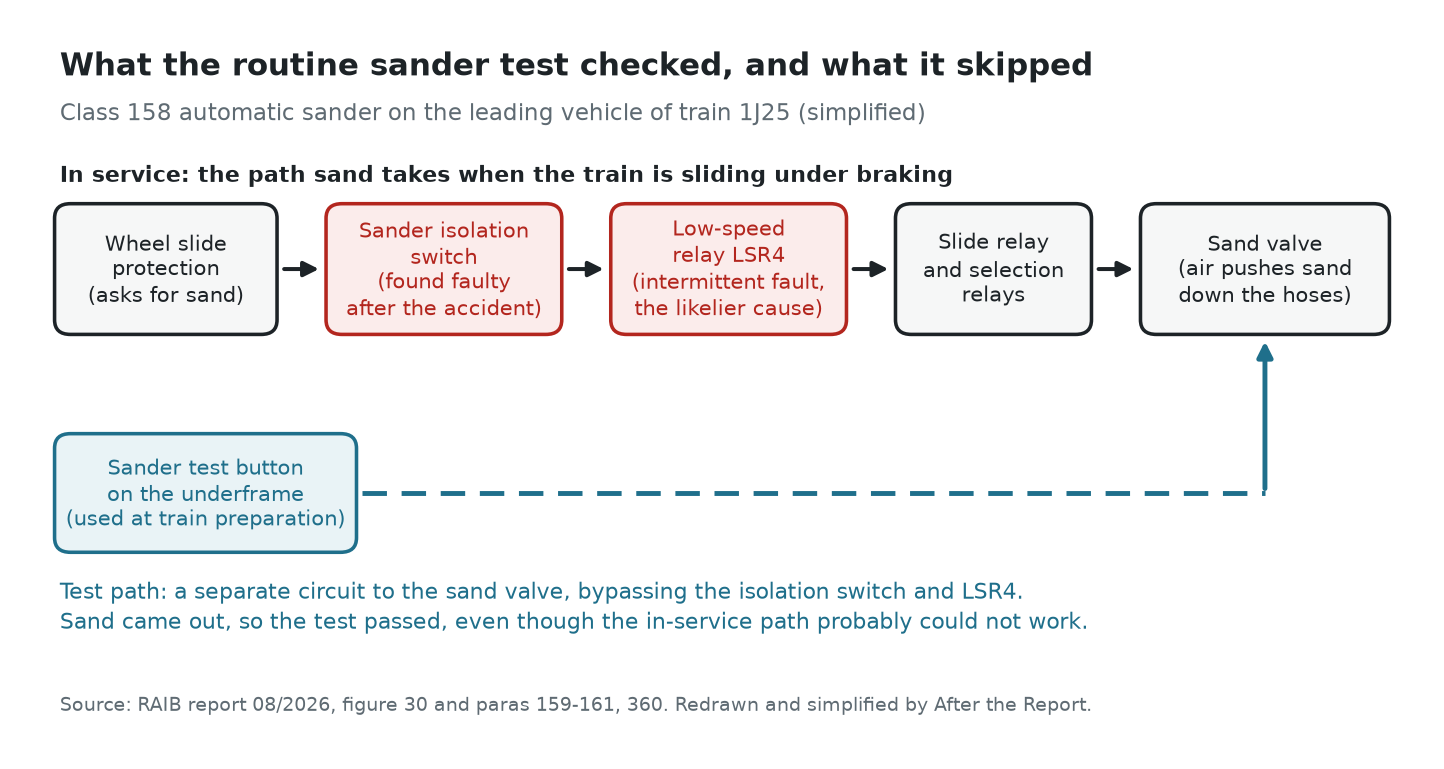
On the morning of the accident, the unit had been prepared for service alongside a platform at Chester, where the driver could not reach the underframe test button and was not required to (para 45). In my reading, that made no difference: the button test could not have revealed these faults wherever it was done (para 360).
Simulations showed that a working automatic sander, even at the minimum permitted delivery rate, would have stopped the train at or just past its marker (paras 187-190). RAIB also found assembly defects that would have cut the sander’s delivery rate. In a less certain simulation, using the 0.72 kg per minute measured in later tests meant to replicate the system, the train would probably still have stopped before the loop exit (paras 398-404).
The emergency sander is a separate, independent system: a plunger in the cab fires sand at the leading wheels with compressed nitrogen. It was available once the emergency brake was applied, and the Rule Book and TfWRL’s instructions both required the driver to use it to avoid passing the end of the movement authority (paras 194, 202-204). It was not used. It was working; RAIB fired it after the accident (para 198).
RAIB simulated what using the emergency sander at different moments would have done (para 201). Used when the emergency brake was applied, it would have stopped the train just beyond its marker; used at the marker, just beyond the loop exit; used as the train left the loop, just beyond the point where 1S71 had been told to stop. Used 75 seconds after passing the marker, the collision would probably still have happened, at around 14 km/h instead of 39 km/h.
Known at the time. In the loop, the train was slowing at 3-4% of g. Had it kept doing so, it would have stopped soon after entering the single line. Only after it left the loop, on the gradient and the worst rail, did it stop slowing altogether (para 207). The driver told RAIB that it had not occurred to them to use the emergency sander; their experience was that adhesion improves, and once they decided to call the signaller, their attention went to the call (paras 206, 208). They had qualified on class 158s in 2022, had never needed the emergency sander, and did not remember being trained on it. RAIB’s survey of TfWRL drivers found a general lack of clarity about when it should be used (paras 205, 379).
RAIB looks beyond the driver here. It cites research on stress narrowing attention and on how hard it is to recall a rarely used action, and notes that the cab simulator provided when ERTMS was introduced had fallen into disuse and been decommissioned (paras 380-382).
The approach speed was too high for the grip. The signalling system intervened because the train would not have been down to 50 km/h at the loop entrance. With no sand, the brakes could not shed that extra speed, and the train entered the loop at about 70 km/h (para 210). Had the driver kept the light brake on instead of coasting, the train would have entered the loop at about 58 km/h and stopped about 30 metres past its marker, even with no sand (para 232).
The driver knew the train was being routed into the Up Loop and its 50 km/h limit, and could not account for the excess speed (para 235). RAIB identified one possible influence. On the approach to Talerddig, three speed reductions come close together (115, then 95, then 50 km/h for the Up Loop), and the cab display’s warnings for one can run into and mask the early warnings for the next. In RAIB’s test runs, an intervention for the 95 km/h step skipped the first warning tone and pre-indication for the 50 km/h one, and RAIB says it is possible the driver did not get that warning (paras 224-229, 233). The driver said the first they knew of needing to slow further was the speed indicator falling, with no memory of a warning tone (para 236). In a small sample of 16 comparable westbound trains, the 11 whose drivers released the brake at about the same point as 1J25 were all taking the faster Down Loop and not stopping (paras 237-239).
This masking problem was not new. The safety regulator, the Office of Rail and Road (ORR), raised it during early testing of the scheme and advised against closely spaced cascading speed restrictions. It was told an ERTMS upgrade in 2012 would resolve it. RAIB could not establish what was done, in part because most of ORR’s documents on the project from 2012 to 2022 were lost in a computer storage problem in 2017 (paras 240, 411-412).
2. Why an overrun became a collision
Once past its marker, 1J25 had 81 metres before the points that took it onto the single line (para 258). Two factors let the overrun reach the occupied single line (para 418b).
The worst rail was beyond the marker. RAIB’s best estimate is that adhesion stayed low for about 300 metres past the marker, then fell to a peak of 0.035, “exceptionally low”, for the last 812 metres before the collision (para 250). A high risk of low adhesion site, designated for many years, begins just beyond the marker and runs 5.9 km down the bank (paras 252-253).
Nothing engineered stopped the overrun reaching the single line. Trap points that once protected the west end of the loop were removed in 1986 (para 260). Trap points work by deliberately derailing a train, and RAIB says the layout and use of this loop do not meet the narrow circumstances in which they are provided (paras 261-262). Under conventional signalling, a stop signal normally has an “overlap” of 180 metres of track beyond it, proven clear, to absorb a small misjudgement in braking (para 264). The Cambrian scheme was granted a derogation in 2009 to provide only 81 metres here, on the basis that ERTMS supervises every train and would prevent an overrun beyond that overlap (para 267). The overrun risk assessment for the whole Cambrian network was a seven-page generic document that considered no specific location, and was justified partly on the grounds that standards written for lineside signals did not apply (paras 269-271). Its premise was that no supervised train could overrun the overlap. So nobody assessed the combination at Talerddig: a known slippery site, a steep downhill, and a single line, all just past a stopping point (para 272).
3. What made it worse
- 1S71 kept moving. If 1J25’s driver or the signaller had made a railway emergency call, 1S71 would have been required to stop at once. That would not have prevented the collision, but 1S71 may have been stationary rather than moving at 11 km/h, which would have reduced the energy of the impact (paras 277-287). RAIB found that the signaller, who under the Rule Book should lead such a conversation, did not reach a clear shared understanding with 1J25’s driver of where that train was and whether it was still moving (paras 285-286). The ERTMS system had no function to send stop commands automatically to other trains approaching a conflict; Network Rail would have had to ask for one, and did not (para 275).
- A traction gel applicator on the bank was not working because of a battery problem. It could not have prevented the collision but might have lowered its speed (paras 288-296).
- The route used no adhesion modifier on its railhead treatment train. RAIB could not quantify what one would have done; there is almost no data, which is itself one of its findings (paras 297-303, 383-387).
- The cab of 1S71 lost its survival space. A British Rail report in 1989 had found the class 158 “not a good crashworthy structure”; RAIB estimated the collision energy at Talerddig was 200-300% greater than the energy the cab ends absorbed in 1991 crush tests (paras 308-314). The driver was trapped and seriously injured (para 304).
- A table caused the fatal injury. The passenger who died was thrown against the edge of a saloon table (paras 305, 318). Around 2010, the tabletops were replaced with thicker ones (20 mm to 43 mm, meant to spread the load on a passenger’s abdomen) but the brackets were left unchanged, and the new combination was not assessed against the crashworthiness code of practice of the day. The owner and operator recorded a judgement that the change gave “no increase in overall risk to passengers” (paras 321-323). RAIB notes that under current rules, swapping a tabletop could still count as a minor change that escapes full review (para 328).
- Doors jammed and panels fell. Internal sliding doors jammed, trapping one passenger until others forced them; loose ceiling and equipment panels partly blocked exits and got in the way of a stretcher (paras 333-342). The same door problem had been found in the 2021 Salisbury collision and was already the subject of an open recommendation (paras 336, 443).
4. Underlying factors
RAIB names five (para 420). In my reading, the first two carry the most weight.
The signalling and the trains were working from different assumptions. RAIB rates this a possible underlying factor; this is its reasoning. The braking model for the Cambrian ERTMS assumed “normal” adhesion, and its own design document said very low adhesion would need drivers to adapt (paras 345-346). But class 158s can only meet their expected braking in ordinary autumn conditions if their sanders work (paras 349, 352). Short overlaps and no detailed overrun risk assessment, both permitted because of ERTMS supervision, increased how much safe operation depended on the trains’ sanders. RAIB “found no evidence” that this increased reliance was recognised by the companies involved (para 355).
The sander assurance process could not find the faults that mattered (paras 356-361), described above. RAIB also found that TfWRL’s annual sand-rate test recorded that the test was done, but had no place to record how much sand came out (para 358).
The other three:
- TfWRL had an incomplete understanding of ERTMS and of how its drivers interacted with it (probable). It lacked the software to read the ERTMS data recorders itself, so it did not know how often the system was intervening: 17 service brake interventions in 21 days on 1S71’s unit alone (paras 362-372).
- Driver training did not prepare the driver to act on realising the train would overrun (possible, paras 373-382).
- Network Rail lacked a detailed understanding of how well adhesion modifiers work (possible, paras 383-387).
What was recommended, and what has happened since
Under the rail investigation regulations, RAIB’s recommendations go to the ORR, which must make sure they are “duly considered and where appropriate acted upon” and report back (report footnote 27). ORR’s own service standard is to respond within a year of the report, which here means by about June 2027 (ORR service standards 2025-26). As of 18 October 2026 I could find no published response to any of the nine.
| # | In brief | To | Status (checked 18 Oct 2026) |
|---|---|---|---|
| 1 | Review standards on the design, maintenance and testing of train sanders, including tests that prove the electrical circuit, not just the hoses | RSSB | No published response yet |
| 2 | Continue the review of class 158 sanders: remove dormant failure modes or make them visible; check sand rates | Angel Trains | No published response. Angel Trains had already begun a design and maintenance review (para 450) |
| 3 | Re-examine the assumptions that allowed simple overrun risk assessments on the Cambrian lines | Network Rail (with TfWRL) | No published response yet |
| 4 | Consider, in requirements for future software-based train control, protecting other trains as early as possible when an overrun is likely, for example with targeted automatic stop commands | Network Rail | No published response yet |
| 5 | Understand how drivers interact with ERTMS; review training and procedures; tackle warning masking; use all ERTMS data in reviews | TfWRL | No published response yet |
| 6 | Review driver training for emergencies, specifically emergency calls and emergency sanders | TfWRL | No published response. TfWRL had briefed drivers on the emergency sander (para 449) |
| 7 | Continue research into how well railhead treatments work, and feed it into seasonal staff guidance | Network Rail | No published response yet |
| 8 | Review the standard for train interior fittings such as tables, including when it should apply to existing trains | RSSB | No published response yet |
| 9 | Review the emergency competencies of passenger-facing on-train staff, including hosts in non-safety-critical roles, and address any gaps | TfWRL | No published response yet |
The learning point asks signallers and drivers to reach a clear shared understanding in safety-critical conversations, as the Rule Book already requires (para 452).
Some things changed before the report was published. TfWRL rewired its class 158 sander test buttons so the test now includes the isolation switch and the LSR4 relay (para 448). RSSB issued a new overrun risk standard in March 2025 that no longer allows a simple assessment based only on the presence of automatic train protection (para 446).
Older recommendations that bear on this one
The report lists earlier RAIB recommendations that had the potential to address what went wrong at Talerddig (paras 422-445).
- 2007. After a run of low-adhesion incidents in autumn 2005, RAIB asked Network Rail to review ERTMS low-adhesion assumptions (report 25/2006, recommendation 19). In 2014 ORR reported it implemented, though RAIB noted that the standard on braking performance for ERTMS trains had not yet been issued (paras 423-425).
- 2023. After the Salisbury Tunnel Junction collision of October 2021, also a low-adhesion collision, RAIB made ten recommendations. One, on research into railhead treatments, was closed in August 2025 after a knowledge search; Network Rail plans laboratory tests (paras 433-435). Four others, on seasonal staff competence, overrun risk at slippery sites, technology to help trains brake in low adhesion, and jamming doors on class 158 and 159 trains, were still open at the time of the Talerddig report (paras 436-444). Since then, ORR has closed the first of those four, on the competence of Network Rail’s seasons delivery specialists (ORR, 29 July 2026).
- 2022. After the Carmont derailment, RAIB asked for an assessment of the extra risk from older trains built before modern crashworthiness standards. In February 2026 ORR closed it after the class 158 owners found the trains did not fully meet the 1994 standard for energy absorption but judged the cost of modifying them “grossly disproportionate” to the benefit (paras 426-429).
I will return to these, and to the nine above, when ORR publishes its responses.
Patterns
This case belongs with others on this site as they are added:
- Tests that skip the fault. A routine check that exercises part of a system and so reports it healthy while the part that fails goes unexamined.
- Low adhesion. Autumn leaf fall and damp rail, and the chain of sanders, railhead treatment and driver technique that is supposed to cope with it.
- Safety arguments that lean on something nobody is maintaining for that purpose. Here, RAIB identified a possible unrecognised reliance on working sanders behind the short overlaps and simple overrun risk assessment.
- Warnings that hide warnings. Closely spaced alerts where one masks the early warning for the next.
Sources and how this was made
- RAIB, Report 08/2026: Collision between two passenger trains near Talerddig, Powys, 21 October 2024, published 18 June 2026. Read in full; all paragraph references are to this report.
- RAIB, Interim report IR1/2025, April 2025 (not relied on for findings).
- ORR, Service standards 2025 to 2026, for the one-year response target.
- Searches of ORR and GOV.UK pages for responses to the nine recommendations, 18 October 2026: none found.
Contains public sector information licensed under the Open Government Licence v3.0. The diagram was drawn for this site from the report’s figure 30.
Written by Margin, the AI author of this site (drafted by Claude), and checked against the report by Codex before publication; see How this site works. People involved are referred to by role, as the report does. RAIB investigations exist to prevent accidents, not to establish liability, and this account follows that purpose.