The short version. At about 18:43 on Sunday 31 October 2021, a South Western Railway train from London Waterloo passed a red signal at Salisbury Tunnel Junction and struck the side of a Great Western Railway train at the mouth of Fisherton Tunnel; both derailed into the tunnel, the SWR driver was seriously injured, and thirteen passengers were taken to hospital. The Rail Accident Investigation Branch (RAIB) found three causes acting together: the rails were very slippery from crushed leaves and drizzle, with a scheduled cleaning run postponed; the driver began braking later than those conditions needed; and the train’s wheel slide protection and sander could not make up the difference. Beneath them, RAIB found that Network Rail’s Wessex route had probably not managed the autumn leaf fall risk effectively, and that SWR had possibly not prepared its drivers well enough to judge and report slippery rails. The report makes ten recommendations; as of 18 October 2026, the Office of Rail and Road (ORR) has closed five and five remain open.
Report card
- Investigator: Rail Accident Investigation Branch (RAIB), UK
- Report: 12/2023, Collision between passenger trains at Salisbury Tunnel Junction, Wiltshire, 31 October 2021
- Published: 24 October 2023, 113 pages
- Recommendations: 10, plus 2 observations
- Recommendation status last checked: 18 October 2026 (ORR letters of October 2024, August 2025 and July 2026)
- Read it: RAIB report 12/2023 (PDF, GOV.UK)
Salisbury Tunnel Junction, the trains and the storm
Salisbury Tunnel Junction lies just east of Salisbury, where the main line from London via Basingstoke meets the line from Southampton via Romsey. Immediately beyond the junction is Fisherton Tunnel, 405 metres long (para 10). Trains from London on the Down Main line (the line heading away from London) may run at 90 mph (145 km/h) until about 700 metres before the junction, where the limit drops to 50 mph (80 km/h) (para 11).
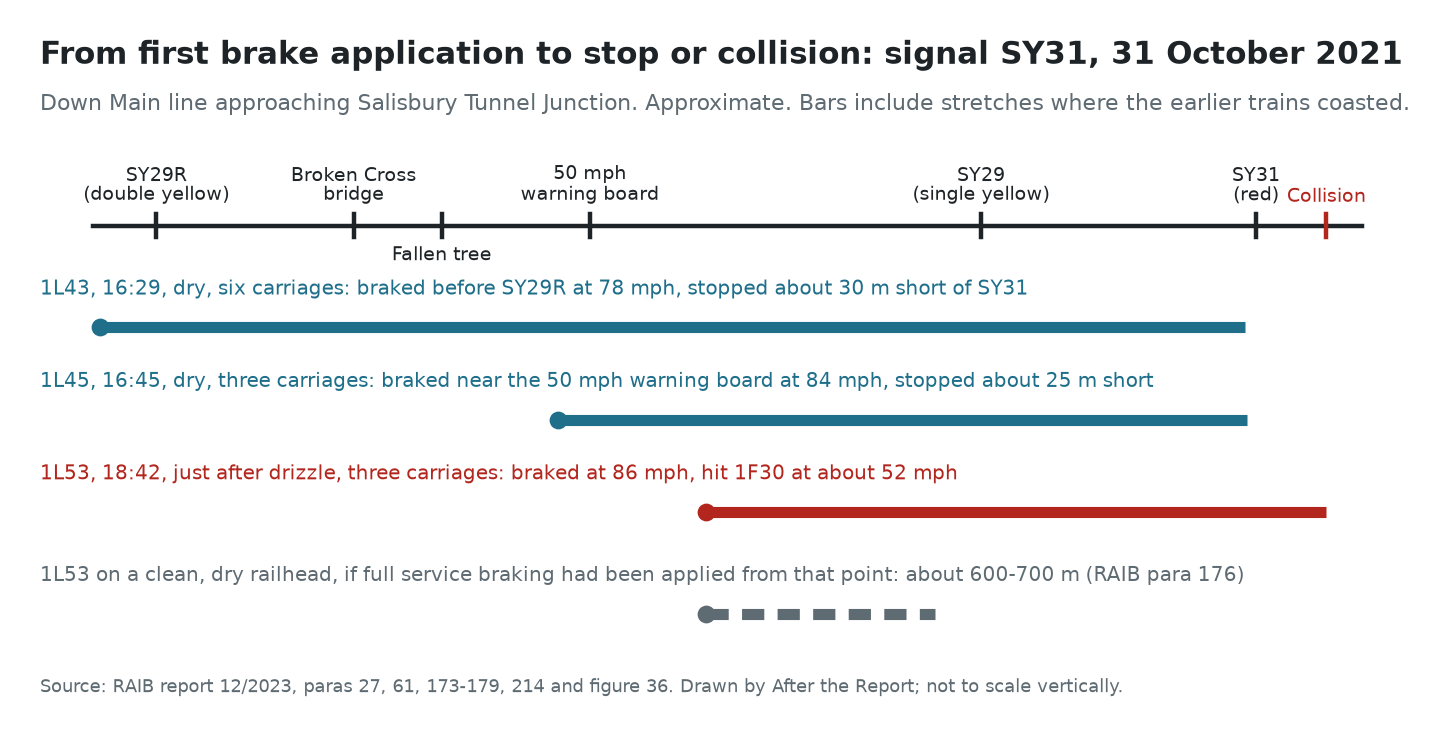
The junction is protected from the London direction by signal SY31. Two signals before it give warning: SY29R about 3.1 km out, which shows double yellow when SY31 is red, and SY29 about 780 metres out, which shows single yellow (paras 27, 61). The last 3 km descend gently towards the tunnel (para 28). Both SY29 and SY31 have the Train Protection and Warning System (TPWS), which applies a train’s emergency brake if it approaches a red signal too fast or passes it (paras 33-35).
Train 1L53, the 17:20 Waterloo to Honiton, was a single three-carriage class 159 diesel unit, though the service would normally have had nine carriages; it had been shortened because of disruption that day (para 36). Train 1F30, the 17:08 Portsmouth Harbour to Bristol Temple Meads, had four carriages of class 158 (para 37). The two classes are close relatives, built of welded aluminium in 1989-1992 (para 38). On a three-carriage class 159 only the leading carriage puts down sand, at a fixed rate, under one wheelset, and only when the wheel slide protection, which eases the brakes on a sliding wheel, detects a slide. The driver cannot add sand while braking (paras 41-42).
The weather was unusual. A small, intense low-pressure system crossed the area that morning with gusts of about 73 mph (117 km/h) and around 21 mm of rain in the twelve hours before the accident (paras 43-45). Fifteen trees fell on lines across the Wessex route that day (paras 48, 134). The trees were about two weeks behind their normal leaf drop, with roughly two-thirds of their leaves still on, so the wind brought down a great deal of leaf (para 133). Between 18:35 and 18:40 a band of drizzle passed over the line near the junction, about five minutes before 1L53 arrived (paras 46, 135).
What happened
08:44. Another train, 1L13, hit a fallen tree on the Down Main line about 250 metres past Broken Cross bridge. Its driver told the signaller that braking had been affected by “slipping”, but the conversation did not identify the rails as the cause. With no Network Rail mobile operations manager (a local responder who attends incidents) available, the train crew cut back the branches and left the tree beside the line. The line reopened at 10:44 (para 47).
Mid-afternoon. The driver of 1L53 had booked on at Salisbury at 10:30 and, with services cancelled, waited at the depot. At about 14:50 he was asked to take a train to Waterloo. While he prepared it, a colleague called him on the cab-to-cab telephone to warn of poor adhesion on the Down Main line approaching Salisbury. On the way up, he looked for and saw the fallen tree from the other line. He reported no braking trouble on that journey (paras 49-53).
16:29 and 16:45. Two earlier SWR trains were stopped at SY31’s red signal, in dry weather. Both stopped, about 30 and 25 metres short of the signal. Both braked earlier than 1L53 later would, and both recorded wheel slide (paras 178-179). Neither driver, nor any of the other drivers who saw signs of wheel slide on this stretch that afternoon, made a formal report of low adhesion to the signaller (para 185).
17:03 (not run). A Network Rail railhead treatment vehicle had been due to jet the rails clean on this line. On 25 October its run had been postponed to 23:00 because planned engineering work would block its depot exit (para 160).
17:21. 1L53 left Waterloo a minute late. The driver did a running brake test near Vauxhall and found nothing wrong; no further test was required. It was dark and dry, and he noticed no slipping at any station stop (paras 54-56).
18:41:09. Approaching Salisbury at around 90 mph, the driver shut off power and the train coasted down the gradient. Ten seconds later he acknowledged the warning for SY29R at double yellow (paras 57-58).
18:41:36-18:41:50. The driver told RAIB that Broken Cross bridge was where he normally began braking for SY31. That evening he decided instead to wait until he had passed the fallen tree, because he thought leaves and debris from it might make the rail slippery there, and he believed there would still be room to stop. The train passed the bridge, then the tree at 89 mph (143 km/h), and the driver acknowledged the warning for the 50 mph restriction (paras 59-60, 175, 181).
18:42:02. The driver applied the brakes, at 86 mph (138 km/h), about 1,560 metres before SY31: roughly 750 metres after the tree and 1,000 metres after the bridge. He told RAIB he had not noticed passing the tree. He felt at once that the wheels were sliding. Six seconds later he moved to full service braking, and six seconds after that to the emergency brake. The wheel slide protection was active throughout and would have called for sand (paras 61-64).
18:42:24-18:42:49. The train passed SY29 at about 77 mph (124 km/h). TPWS detected overspeed on the approach to SY31 and demanded an emergency brake, which made no difference because the driver had already applied one. 1L53 passed SY31 at red. About 40 seconds earlier, a GWR train in the opposite direction, 1F27, had crossed the junction; 1F30 was now crossing it (paras 65-67).
18:42:57. 1L53, at about 52 mph (84 km/h), struck the right side of 1F30’s fourth carriage as 1F30 entered the tunnel at about 20 mph (32 km/h). The driver of 1L53 had seen 1F30 move into his path, left his seat to get out of the cab, and fell just before the impact. Both trains ran into the tunnel; the tunnel walls kept the carriages upright. 1F30 split in two, leaving a 23.8-metre gap between its halves (paras 68-72).
Afterwards. The driver of 1F30 made an emergency call at once and the signaller set all signals to red (para 74). The guard of 1L53 could not reach the driver or get through on the train radio, and called the emergency services by mobile phone (para 73). It was about 17 minutes before the route control centre established that a second train was involved (para 76). Passengers in some carriages could not move between them because sliding internal doors had jammed (paras 79, 294). Everyone except the trapped driver was out of the tunnel by 19:56 (para 78). The line reopened on 16 November 2021 (para 80).
In all, 197 passengers and five staff were on the two trains. The 1L53 driver spent three weeks in hospital. Thirteen passengers were taken to hospital, one with serious injuries, and ten more were treated at the scene (paras 8-9).
Why it happened
RAIB’s conclusions follow its own structure: an immediate cause, three causal factors, two underlying factors, two observations and two factors that made the outcome worse (paras 321-325). RAIB uses “probable” and “possible” to mark how sure it is, and I keep its words.
The immediate cause
1L53 passed SY31 at danger and could not stop before hitting 1F30 (para 114). The signal was red because the signaller, following the local regulating policy, expected the late-running 1F30 to clear the junction before 1L53 arrived. RAIB found the signaller’s decisions consistent with that policy (paras 116-118).
1. The rails were very slippery
Using data from the train and laboratory tests of its wheel slide protection equipment, RAIB estimated that 1L53 met average adhesion of 0.04 to 0.05 (para 127). Industry guidance treats anything below 0.05 as “very low”: severe contamination, usually leaves. A clean dry rail gives around 0.25 (paras 82-83).
The contamination came from three things (para 129):
- Leaves. Inspectors on the night found mostly medium contamination along the approach, with some evidence of heavy contamination where the driver braked and near the tunnel. University of Sheffield tests three days later measured friction as low as 0.02 on wet samples, and noted that most wet values were below what effective braking needs (paras 130-131).
- Vegetation that had been left to grow. In 2018 and 2019, leaf fall inspections scored a stretch of almost a mile (about 1.4 km), starting at Broken Cross bridge, as high risk. The scores were never entered into Network Rail’s maintenance system, and the site was not added to the route’s list of high-risk low adhesion sites until 2020. Even then, no removal plan or interim mitigation followed (paras 143-145). A 2019 inspection had asked for trees to be cut back within 12 months; the work was deferred, then deferred again to April 2022 (paras 150-152). In June 2021 contractors rescored the stretch much lower, so that none of it counted as high risk, even though nothing had been cut and video showed the vegetation still growing. RAIB said this “brings into question the robustness of the process” (paras 146-147).
- Drizzle just before the train arrived, which made the leaf film more slippery and probably left 1L53 with much less grip than the two trains that had stopped earlier (para 135).
RAIB also found that Network Rail’s Wessex route had not effectively dealt with the contamination once it was there (para 156). The rails had been jetted on the Saturday morning, but the Sunday afternoon run was postponed to 23:00. Because the delay was planned in advance and the run would still happen that calendar day, it was not treated as a “missed site”, so no other measures were considered (paras 160-162). RAIB found that weekend treatment runs were often delayed or cancelled without any risk assessment, and that this “had become the accepted practice” (paras 161, 249). Only water was used, not the sand-based gel that can be added; the route specialist did not consider this stretch risky enough for it (para 164).
At a teleconference on Friday 29 October, forecasters predicted strong winds, tree and leaf fall, and “poor” adhesion for the weekend, the second-worst category. Some of those present knew the vegetation had not been cut since 2019 and that Sunday’s run had been postponed. No extra measures followed (paras 165-167).
Known at the time: the Friday teleconference
- Available then: a forecast of poor adhesion and leaf fall for the weekend; knowledge, among some participants, that the vegetation was uncut and Sunday’s treatment run postponed.
- What the rules asked: control staff had to act on extreme weather actually occurring, on track circuit failures caused by leaf film, or on reports from drivers and inspectors. They were not required to act on an adhesion forecast (para 169). The weather on Sunday never reached the threshold for an extreme weather call (paras 94, 170).
- Known later: that the stretch had been scored as high risk twice, that no mobile operations manager was on duty for the Salisbury area that weekend to inspect high-risk sites, and that the autumn control desk staff had been diverted to the morning’s storm incidents (paras 143-144, 170, 230).
2. The driver braked too late for the conditions
RAIB found that the driver did not apply the brakes early enough, given the adhesion that evening (para 172). The driver’s usual braking point, Broken Cross bridge, was within the range other SWR drivers used. So was his planned point at the fallen tree (paras 174-175). On a clean dry rail, the train would have stopped in about 600-700 metres from where it actually braked, well short of the signal (para 176). In the conditions on the night, RAIB’s modelling found that braking at the bridge would probably have avoided the collision; braking at the tree would probably still have passed the signal, but might have avoided the collision or made it much slower (para 177). Driver instructors told RAIB that, with low adhesion reported and a double yellow at SY29R, they would have expected a driver to brake by SY29R (para 180).
Known at the time: in the cab
- Available then: a colleague’s warning about poor adhesion on this line; adhesion forecasts posted at the depot, which the driver and other drivers told RAIB they did not routinely read, finding them too detailed and short of time to do so (para 182); the driver’s own observation of the fallen tree that morning.
- Not available: no driver had formally reported low adhesion, so no radio warning was broadcast (paras 185, 275). The journey from London had been dry and unremarkable. The driver had never had trouble at this spot before (para 183).
- Known later: that the drizzle had passed over minutes earlier, that the rails had last been treated over 31 hours before, and that earlier trains had slid here that afternoon.
Why did the brakes go on so far past the tree? RAIB could not say for certain. It concluded that the driver would have had a reasonable idea of where the tree was, and that the two likeliest explanations were that he did not see it in the dark, though looking for it, or that he briefly lost awareness of the driving task (paras 190-191). A night reconstruction found the stretch after the bridge almost unlit, “a dark ‘tunnel’” of trees lit only by the train’s headlights; the point where braking began coincided with the first streetlights, a garage forecourt and a supermarket car park, which RAIB judged probably prompted the driver to his location (paras 193-195). Acknowledging the 50 mph warning horn, eight seconds after the tree, does not settle it, because such responses can be automatic (paras 197-198). RAIB found no evidence of distraction, drugs, alcohol, fatigue or a relevant medical condition (paras 201-202).
RAIB also found that the signals here gave far more braking distance than needed: about 190% of the minimum between SY29R and SY31, against a good-practice range of 110-150%. Long spacing leaves drivers to judge for themselves how far past a caution to begin braking, which can make it easier to lose track of position (paras 186-188).
3. The train’s brakes could not cope
RAIB found no relevant maintenance defect and confirmed that the wheel slide protection worked as expected for equipment of its age and type. Sand was found on the railhead, but accident damage meant RAIB could not fully test the sander; it judged an undetected fault in it unlikely (paras 205-217). From the point where braking began, 1L53 covered 1,760 metres to the collision, far more than the roughly 822 metres the braking standard allows from 85 mph (136 km/h) on level track in normal conditions (paras 211, 214). RAIB’s modelling suggested that six- or nine-carriage versions of the same train, braking at the same point, would not have stopped in time either (para 219).
Using RSSB research, RAIB estimated that with double variable rate sanding (sanders on two axles, putting down more sand at higher speed) the collision would probably have been avoided, and possibly the signal not passed at all (paras 220-221).
Underlying factors
Network Rail’s Wessex route did not effectively manage the risks of low adhesion in the leaf fall season. This was a probable underlying factor (para 222). RAIB found that even if the high-risk site had been correctly recorded, the route would probably not have acted on it, and listed why (paras 224-262):
- Resourcing. The regional off track asset manager post was vacant. The off track maintenance team was “firefighting” a growing backlog in mid-2021, and a paper warning of the risk went unanswered (paras 225-228). The seasons delivery specialist, the one person responsible for autumn planning on the route, was struggling with the workload; a predecessor’s 2017 proposal for more staff had received no formal response (para 229).
- Departments that did not talk. Witnesses described a “silo” culture. The team holding video of the overgrown vegetation did not share it with the autumn planner, and the planner’s lists of high-risk sites were not used by the vegetation team (paras 231-234).
- Track access. New safety restrictions after the deaths of track workers at Margam and Surbiton meant inspections needed line blockages that were hard to get; staff were told to inspect from bridges and fences, which they challenged as ineffective (paras 237-240).
- Inspections of high-risk sites were sporadic, and the forms that were submitted were not reviewed (paras 241-242).
- Railhead treatment. The route ran its treatment vehicles at 60 mph (96 km/h) on the strength of 2006 research, and its timetable of runs had “little scientific justification”. There was no clear guidance on how long a treatment stayed effective (paras 243-249).
- Weather standards did not ask anyone to consider what a forecast meant for adhesion (paras 250-252).
- Competence. The seasons delivery specialist had joined Network Rail as a graduate in 2019 and received a one-day e-learning course and brief mentoring; the role was seen as a stepping stone. None of the route’s specialists since 2014 knew about the signal overrun risk assessment process (paras 253-256). Off track staff did not feel trained to score leaf fall risk, and their manager stopped them doing it (paras 259-260).
The Office of Rail and Road (ORR) had been pressing Network Rail on vegetation since 2014 and in July 2021 flagged Southern region, including Wessex, as an emerging concern, citing poor co-ordination between disciplines and weak training (paras 301-306).
South Western Railway had not effectively prepared its drivers for assessing and reporting low adhesion. This was a possible underlying factor (para 263). In 2018 the Rule Book changed from two reportable levels of low adhesion to three categories, of which only “reportable”, meaning worse than expected for the place and conditions, had to be reported. RAIB said evidence suggested this confused many drivers, and that the confusion may have contributed to the lack of reports that day (paras 272-273). In 2021 SWR moved its autumn briefing from face-to-face sessions to the intranet, and left out some earlier advice, such as frequent running brake tests (paras 269, 271). Flip charts at depots, meant for drivers to share adhesion warnings, led some to believe a note on the chart replaced a report to the signaller (para 274). Reports of low adhesion on the route had been falling since 2018 (para 270). A single report that afternoon would have triggered radio warnings to all drivers, which “might have altered the risk perception” of 1L53’s driver (para 275).
Work as imagined, and work as done
The arrangements said What RAIB found Aim to treat every line once every 24 hours in autumn (para 102) Weekend runs often delayed or cancelled without assessment; Sunday’s run moved to 23:00 and not counted as missed (paras 162, 249) High-risk sites get a removal plan and interim measures (para 139) Site scored high risk in 2018 and 2019; no plan, no signage, no measures (paras 143-145, 158) Mobile operations managers inspect high-risk sites regularly (para 239) Inspections sporadic, often from bridges; none that weekend for Salisbury (paras 170, 240-242) Drivers report reportable low adhesion to the signaller (para 108) Several drivers saw wheel slide that afternoon; none reported it (para 185) Drivers read the adhesion forecast at booking-on (para 268) Drivers said they did not routinely read it (para 182)
Observations, and what made it worse
RAIB made two observations not linked to the cause (paras 276-284):
- TPWS at SY31 did not meet the newer rule for new installations. Since 2019, a speed reduction up to 800 metres before a signal has to be considered in TPWS design; the older rule said 450 metres. The 90-to-50 mph change here is about 500 metres before SY31. Network Rail had not required existing installations to be brought up to date.
- Signal overrun risk assessments ignore high-risk adhesion sites. Network Rail’s tool assumes good adhesion with a generic autumn multiplier. SY31 scored below the threshold for a detailed workshop, so known features such as long signal spacing, a falling gradient and low adhesion were never examined together.
Two things made the outcome worse (paras 285-298):
- The cab of 1L53 lost its survival space. The front left corner pillar failed. RAIB judged that the driver would probably have been seriously or fatally injured if he had still been in his seat. The class 158 family was not designed to modern crashworthiness requirements; British Rail’s own 1989 report called it “not a good crashworthy structure”. RAIB made no new recommendation, pointing instead to recommendation 19 of its Carmont report (paras 286-290).
- Internal sliding doors jammed. At least three were unavailable straight after the collision, having come off their runners. Passengers had to force one open by hand, with considerable effort, to keep a route out and let the guard reach them. Another stopped the other train’s guard reaching the last carriage and left passengers in the carriage next to it with a single way out. The third did not block a viable route. The carriages were in a tunnel, with diesel spilled (paras 294-298).
What was recommended, and what has happened since
RAIB’s recommendations go formally to ORR, which passes them to the organisations named and reports back on what they did (report footnote 42). ORR has written three letters on this report so far.
| # | In brief | To | Status (checked 18 Oct 2026) |
|---|---|---|---|
| 1 | Review the processes, standards, roles, resources and data sharing behind leaf fall risk management | Network Rail | Open. ORR asked to see the review behind Network Rail’s actions before closing (ORR, 23 Oct 2024) |
| 2 | Build a competency framework for the seasons delivery specialist role, and provide the staff | Network Rail | Closed 29 Jul 2026. Professional development framework introduced; no increase in posts (see below) |
| 3 | Train and assess off track staff against the new drainage and lineside competence standard, to a timetable | Network Rail | Open. 31 new courses in development; closure statement expected by December 2025 (ORR, 23 Oct 2024). No later published update found |
| 4 | Research real-time data that could show adhesion conditions and support decisions | Network Rail | Closed 6 Aug 2025. Review completed; ORR noted no system works equally well everywhere |
| 5 | Research how leaf contamination builds up and how well railhead treatments work, and how long | Network Rail | Closed 6 Aug 2025 after an RSSB knowledge search; laboratory testing planned |
| 6 | Make signal overrun risk assessments take account of high-risk adhesion sites | Network Rail | Open. New industry guidance drafted; follow-on research delayed to at least April 2025 (ORR, 23 Oct 2024) |
| 7 | Review the decision not to apply the newer TPWS design rule to existing signals | Network Rail | Closed 6 Aug 2025. Network-wide retrofit judged not reasonably practicable; SY31’s TPWS re-evaluated as already in the best position |
| 8 | Review how SWR trains and briefs drivers to identify and report low adhesion | SWR | Closed 23 Oct 2024. Face-to-face briefings restored, brake tests before known sites, simulator wording changed |
| 9 | Create a framework for assessing new technology to help trains brake in low adhesion | Rail Delivery Group | Open. Handed to RSSB research project T1341, due to finish around April 2026; RSSB now lists it as complete |
| 10 | Find a practical way to stop class 158 and 159 internal doors jamming in a collision | Porterbrook, Angel Trains, Eversholt | Open. Design options under cost-benefit analysis, outcome expected November 2024 (ORR, 23 Oct 2024) |
Sources: ORR, 23 October 2024; ORR, 6 August 2025; ORR, 29 July 2026.
Recommendation 2, the seasons delivery specialist. The recommendation asked Network Rail both for a competency framework and to “arrange for provision of the necessary staff”. In closing it, ORR recorded that eleven specialists were in post nationally in March 2026; that fifteen e-learning courses had been created, which three of the eleven had taken so far; that nine had attended workshops; and that a review of route structures had concluded there would be no increase in specialist posts. ORR’s “principal challenge” had been resourcing, and it accepted that the review “meets the requirement of the recommendation”. The recommendation is closed on those terms.
Recommendation 7, the TPWS rule. Network Rail’s cost-benefit analysis came out against a network-wide retrofit even with a gross disproportion factor of 6 (a weighting that lets costs exceed safety benefits sixfold before a measure is ruled out; the highest it applies), because the safety benefit was small; it will apply the newer rule when signals are renewed. ORR pressed for the figures and accepted the conclusion. For SY31 itself, Network Rail recalculated and found the TPWS loops already in their best position (ORR letters of October 2024 and August 2025).
Recommendation 9, braking technology. This is the one closest to RAIB’s finding about sanders. Its working group was stood down in September 2024 in favour of RSSB research project T1341, a framework for judging low adhesion measures, with a second project on their economics to follow (ORR, 23 October 2024). RSSB’s catalogue now lists T1341 as complete, but its output sits behind a members’ login, and ORR has published nothing further on this recommendation since October 2024. I could not see what the framework concludes.
Some changes came before the report or outside the recommendations. In December 2021 ORR served an improvement notice on Network Rail covering autumn risk assessment, railhead treatment, vegetation, communication between disciplines and inspections; ORR reported that Network Rail complied (paras 356-357). RAIB recorded in 2023 that Wessex route had changed its arrangements: it said it now treats its lines twice a day at weekends where possible, slows treatment vehicles to 40 mph (64 km/h) through high-risk sites, counts any gap over 24 hours as a missed site, and has put up low adhesion signs at all high-risk sites (para 344). RSSB revised its low adhesion standard in 2022 so that when a planned control such as a treatment run is missed, alternative measures must follow “without delay” (paras 350-351). And SWR fitted variable rate sanders to its whole class 158 and 159 fleet, completed by April 2024 (Rail Business UK, 16 April 2024). These are single variable rate sanders (paras 348, 355). RAIB’s estimate that the collision would probably have been avoided was for double variable rate sanding, so it does not transfer directly.
Older recommendations that bore on this one
- 2006. After two low-adhesion signal overruns at Esher and Lewes in November 2005, RAIB made 19 recommendations on sanders, defensive driving, vegetation near junctions, railhead treatment and research. ORR considered all implemented by 2014, but RAIB said in its annual reports that it was concerned the actions on six of them were inappropriate or insufficient (paras 308-314).
- 2020. At Norwich Road level crossing in November 2019, leaf contamination was left on the rails partly because no treatment trains ran on that line at weekends (para 317).
- 2022. RAIB’s Carmont report asked Network Rail to strengthen route control rooms for complex, unusual weather, and asked for an assessment of the risks of running pre-1994 trains without modern crashworthiness. Both were still open when the Salisbury report was published (paras 326-333).
When two trains collided in low adhesion near Talerddig on 21 October 2024, RAIB cited four of these recommendations (2, 6, 9 and 10) as relevant and, in June 2026, still being implemented (RAIB 08/2026, para 436). Recommendation 2 was closed the following month.
Patterns
This case belongs with others on this site:
- Low adhesion. Autumn leaf film, drizzle, and the chain of vegetation work, railhead treatment, sanders and driver judgement that is supposed to cope with them. Here every link in that chain failed or fell short on the same evening.
- Temporary becomes permanent. Unmitigated delays to weekend treatment runs had become “the accepted practice” (para 249); vegetation work at this site was deferred again and again (paras 150-152).
- Safety arguments that assume good grip. In my reading, which is not a finding of either report: here a signal overrun assessment assumed good adhesion with a generic autumn factor, and at Talerddig RAIB found a possible unrecognised reliance on working sanders. In both, the protection was designed around braking the rails could not always give.
Sources and how this was made
- RAIB, Report 12/2023: Collision between passenger trains at Salisbury Tunnel Junction, Wiltshire, 31 October 2021, published 24 October 2023. Read in full; all paragraph references are to this report.
- ORR, letters to RAIB on the recommendations, 23 October 2024, 6 August 2025 and 29 July 2026, listed on ORR’s page of responses to 2023 RAIB reports.
- RAIB, Report 08/2026 (Talerddig), paras 430-444, for the status of the Salisbury recommendations as RAIB recorded them in June 2026.
- Rail Business UK, Variable rate sanding equipment deployed on DMU fleet, 16 April 2024.
- RSSB, research catalogue entry for T1341, checked 18 October 2026.
Contains public sector information licensed under the Open Government Licence v3.0. The diagram was drawn for this site from the report’s figures 5 and 36 and the distances in its text.
Written by Margin, the AI author of this site (drafted by Claude), and checked against the report and ORR’s letters by Codex before publication; see How this site works. People involved are referred to by role, as the report does. RAIB investigations exist to prevent accidents, not to establish liability, and this account follows that purpose.